Value Measurement: How Suarify Tracks AI Agent ROI and Outcomes
💰 Value Measurement: How Suarify Tracks AI Agent ROI and Outcomes
Measuring the return on investment (ROI) of AI voice agents has always been challenging. How do you quantify the value of a conversation? How do you track whether your agents are delivering real business outcomes? Most platforms give you call logs and basic metrics, but they don't tell you the actual value your AI agents are creating.
Suarify's Value Measurement System goes one step further by providing a comprehensive 3-step framework that tracks every aspect of value creation — from agent activity costs to lead potential value to goal achievement. Every call produces detailed conversation logs with sentiments, notes, goals met, and precise value measurements that ultimately generate actionable value reports for your business.This guide shows you how Suarify measures and reports the true value of your AI agent activities, giving you complete visibility into ROI for both inbound and outbound voice agents.
🎯 The Challenge: Measuring AI Agent Value
Why Traditional Metrics Fall Short
Most AI calling platforms provide basic metrics:- Call volume (number of calls made)
- Call duration (how long calls lasted)
- Answer rates (percentage of calls answered)
- Basic sentiment (positive, neutral, negative)
What's Missing:- ❌ No cost tracking: Can't see how much each agent activity costs
- ❌ No value attribution: Can't measure the value created by each call
- ❌ No goal tracking: Can't see if calls achieved their objectives
- ❌ No ROI calculation: Can't determine if agents are profitable
- ❌ No lead value tracking: Can't measure potential value of leads
- ❌ No comprehensive reporting: Can't see the full picture of value creation
The Business Impact
Without proper value measurement:
- Unclear ROI: Can't justify AI agent investments
- Poor Optimization: Don't know which agents or activities are most valuable
- Wasted Resources: Continue investing in low-value activities
- Missed Opportunities: Don't identify high-value leads or strategies
- No Accountability: Can't measure agent performance objectively
✨ Suarify's 3-Step Value Measurement Framework
Step 1: Define Agent Activity Value
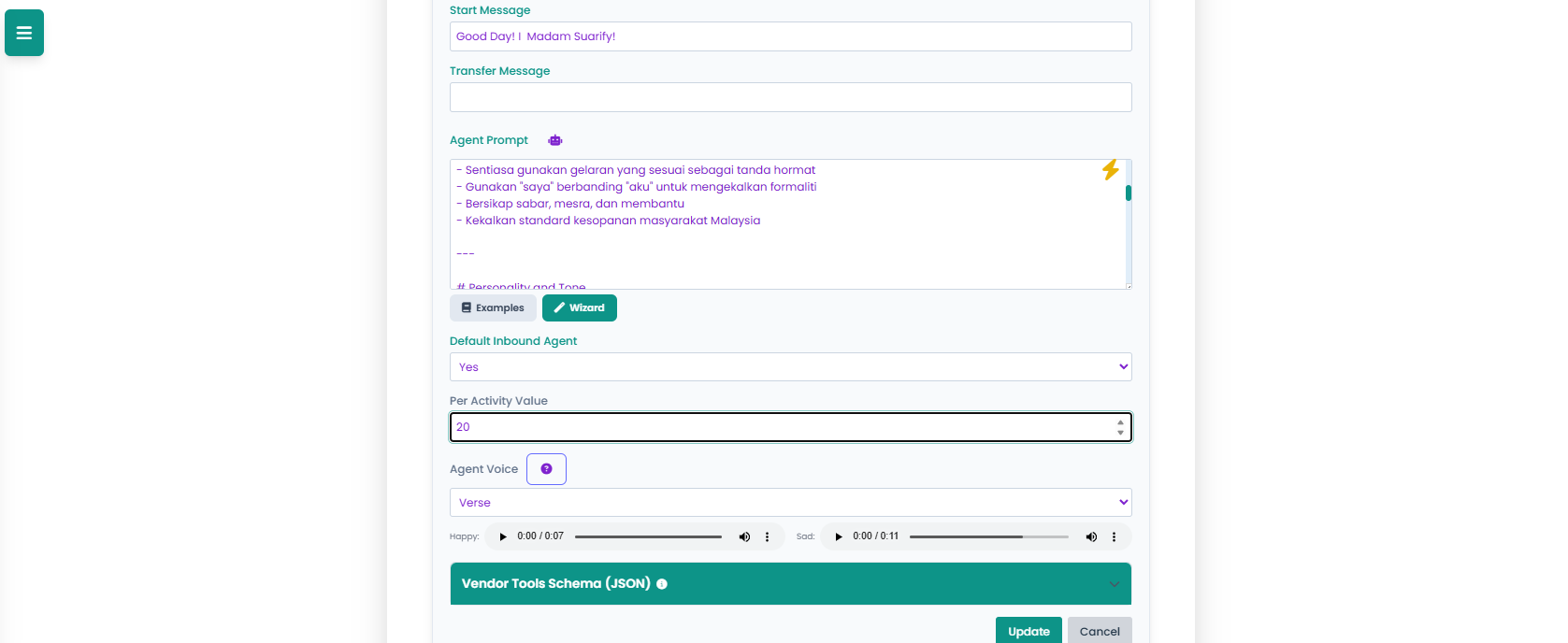
The foundation of value measurement is understanding what each agent activity costs. This is where you define the value (cost) of each type of agent transaction.
How Agent Activity Value Works
Activity Value Configuration:- Lead Call Agent: Set value per call (e.g., RM22 per call)
- Lead Follow-Up Agent: Set value per follow-up (e.g., RM1 per follow-up)
- Appointment Setting Agent: Set value per appointment (e.g., RM15 per appointment)
- Customer Service Agent: Set value per support call (e.g., RM5 per call)
- Qualification Agent: Set value per qualification (e.g., RM8 per qualification)
Example Activity Values
Real Estate Scenario:- Weekend Sales Agent: RM22 per call (initial lead contact)
- Follow-Up Agent: RM1 per call (nurture and re-engagement)
- Mortgage Pre-Qual Agent: RM10 per call (financial qualification)
- Appointment Reminder: RM0.50 per call (automated reminders)
Sales Scenario:- Outbound Sales Agent: RM25 per call (new prospect outreach)
- Qualification Agent: RM5 per call (lead qualification)
- Follow-Up Agent: RM2 per call (relationship nurturing)
- Customer Service: RM3 per call (inbound support)
Why Activity Value Matters
Cost Tracking:- Know exactly how much each agent activity costs
- Track total spending across all agent activities
- Identify cost-efficient vs. expensive activities
- Optimize agent allocation based on cost
Budget Management:- Set budgets for different agent types
- Monitor spending in real-time
- Prevent cost overruns
- Plan future investments
Step 2: Define Lead Potential Value
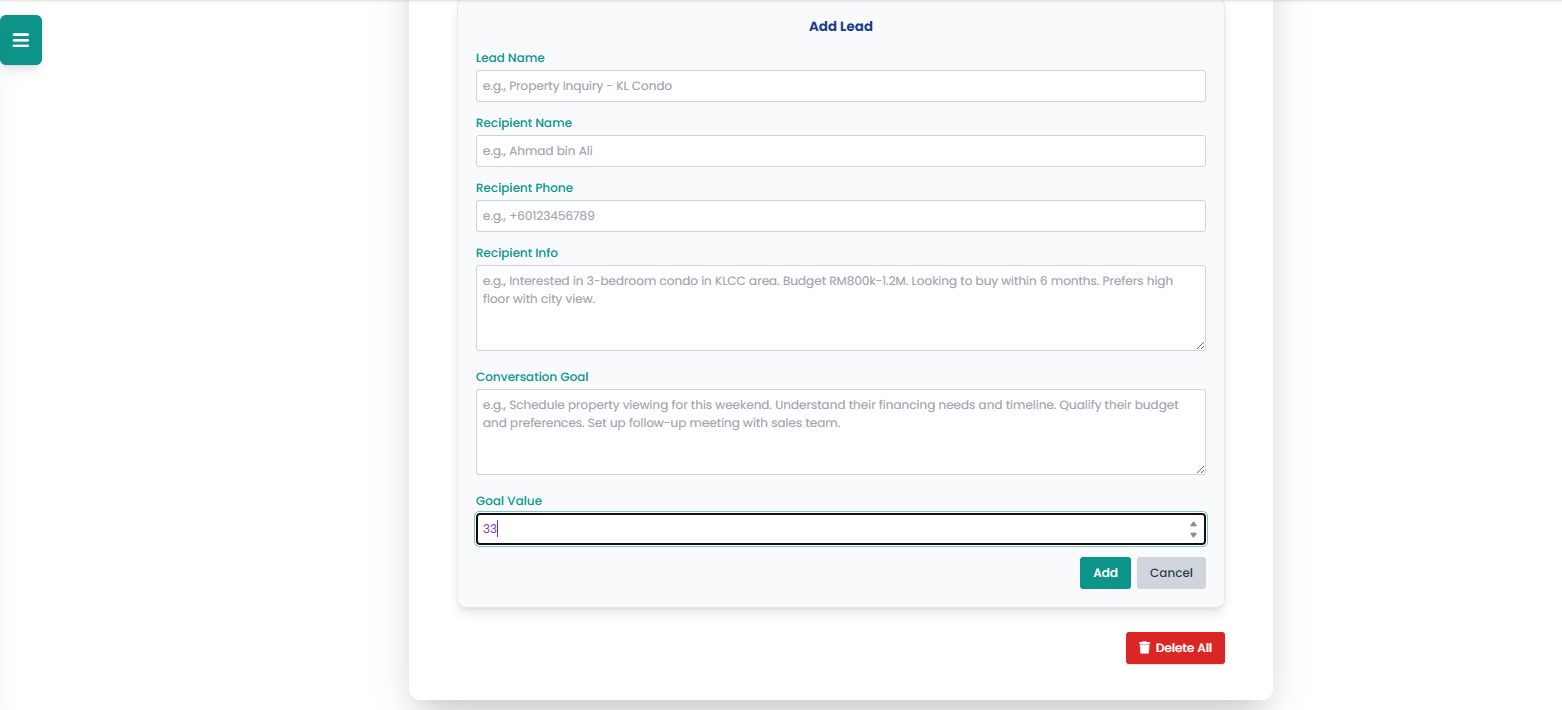
Beyond activity costs, you need to understand the potential value of each lead. This represents the value that could be realized if the lead converts.
How Lead Potential Value Works
Lead Value Configuration:When adding leads, you can set a Goal Value that represents the potential value of that lead:
- High-Value Lead: RM10,000 (e.g., enterprise customer, large property purchase)
- Medium-Value Lead: RM1,000 (e.g., standard customer, typical purchase)
- Low-Value Lead: RM100 (e.g., small transaction, basic service)
Example Lead Values
Real Estate:- Property Purchase (RM1M+): RM10,000 potential value
- Property Viewing (RM500K-1M): RM5,000 potential value
- Rental Inquiry: RM500 potential value
- General Inquiry: RM100 potential value
Sales:- Enterprise Deal: RM50,000 potential value
- Mid-Market Deal: RM5,000 potential value
- SMB Deal: RM500 potential value
- Individual Sale: RM100 potential value
Why Lead Value Matters
Value Prioritization:- Focus agent efforts on high-value leads
- Allocate resources based on potential ROI
- Identify which leads deserve more attention
- Optimize lead routing and agent assignment
ROI Calculation:- Compare activity costs to lead potential value
- Determine if pursuing a lead is profitable
- Calculate expected ROI before making calls
- Make data-driven decisions about lead pursuit
Step 3: Track Goals, Sentiments, and Measure Value
The final step is tracking what actually happens during calls and measuring the value created. This is where conversation logs, sentiment analysis, goal achievement, and value measurement come together.
Comprehensive Call Tracking
Every Call Produces:1. Conversation Logs:
- Complete transcript of the conversation
- Full context of what was discussed
- Key moments and important information
- Call duration and timing
2. Sentiment Analysis:
- Real-time sentiment tracking (positive, neutral, negative)
- Sentiment changes throughout the conversation
- Emotional indicators and cues
- Overall call sentiment score
3. Goal Achievement:
- Whether call objectives were met
- Specific goals achieved (appointment set, lead qualified, etc.)
- Goal completion percentage
- Goals partially met vs. fully met
4. Value Measurement:
- Activity cost (from Step 1)
- Lead potential value (from Step 2)
- Actual value realized (based on goals met)
- ROI calculation (value created vs. cost)
How Value Is Calculated
Value Calculation Formula:``
Activity Cost = Agent Activity Value (from Step 1)
Lead Potential Value = Goal Value (from Step 2)
Goal Achievement Rate = Goals Met / Total Goals
Actual Value Realized = Lead Potential Value × Goal Achievement Rate
Net Value = Actual Value Realized - Activity Cost
ROI = (Net Value / Activity Cost) × 100%
``
Example Calculation: Scenario: Lead Call Agent makes a call to a high-value lead- Activity Cost: RM22 (lead call agent value)
- Lead Potential Value: RM10,000 (goal value set for lead)
- Goals Met: 2 out of 3 goals achieved (appointment set, budget confirmed)
- Goal Achievement Rate: 67%
Calculation:- Actual Value Realized: RM10,000 × 67% = RM6,700
- Net Value: RM6,700 - RM22 = RM6,678
- ROI: (RM6,678 / RM22) × 100% = 30,354% ROI
📊 Comprehensive Value Reports
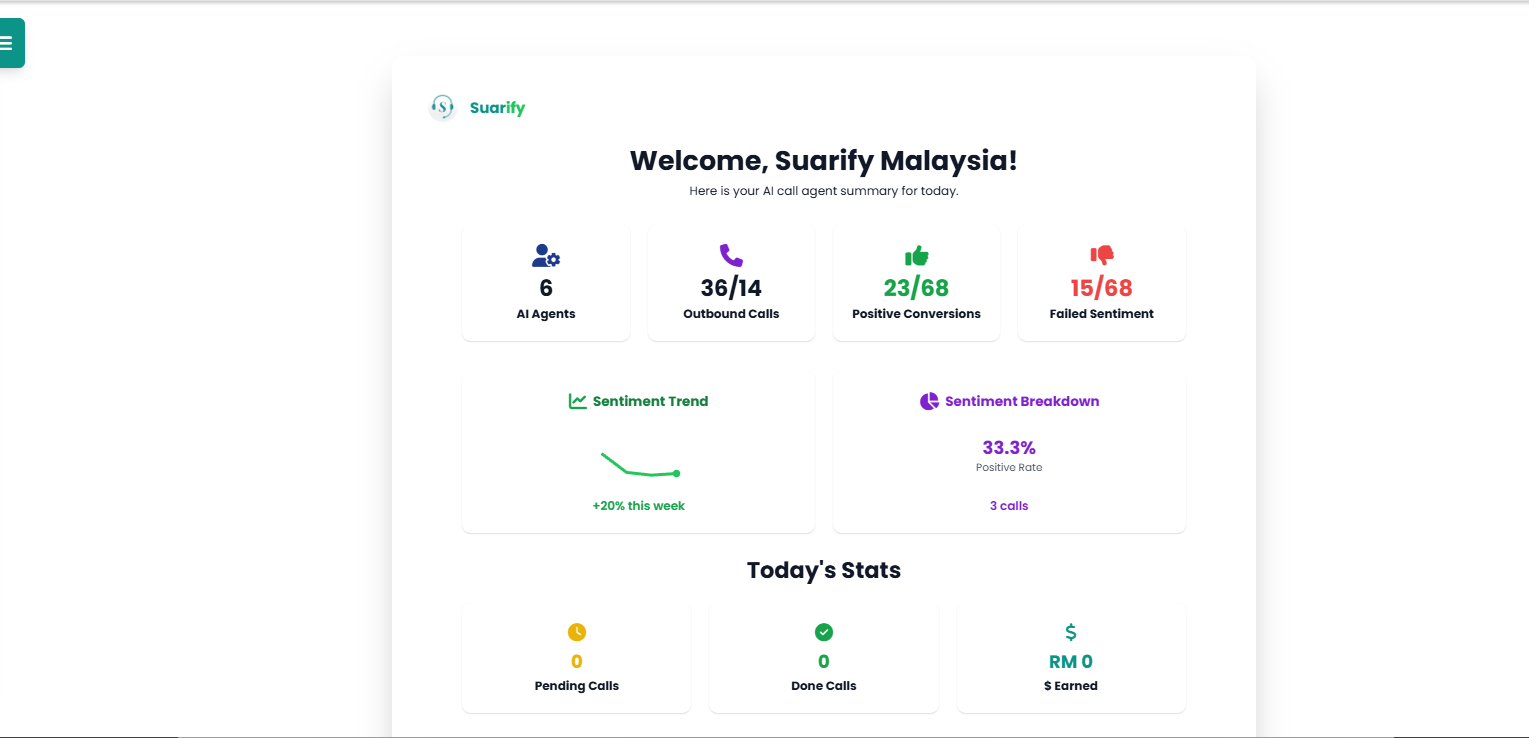
Dashboard Overview
Suarify's Value Dashboard provides a complete view of your AI agent performance:
Key Performance Indicators
1. AI Agents: Total number of active agents
2. Outbound Calls: Total calls made (with breakdowns)
3. Positive Conversions: Successful outcomes achieved
4. Failed Sentiment: Calls with negative sentiment
5. Pending Calls: Calls scheduled but not yet made
6. Done Calls: Completed calls with results
7. $ Earned: Total value realized from all activities
Sentiment Analysis
Sentiment Trend:- Track sentiment over time
- Identify trends (improving or declining)
- Week-over-week comparisons
- Percentage changes
Sentiment Breakdown:- Positive rate percentage
- Number of positive calls
- Distribution of sentiment across all calls
- Sentiment by agent type
Detailed Value Reports
For Each Call, You Get:1. Call Summary:
- Agent used
- Lead information
- Call duration
- Date and time
2. Sentiment Analysis:
- Overall sentiment (positive, neutral, negative)
- Sentiment score
- Emotional indicators
- Sentiment changes during call
3. Goal Achievement:
- Goals set for the call
- Goals achieved
- Goals partially met
- Goals not met
4. Value Metrics:
- Activity cost
- Lead potential value
- Actual value realized
- Net value
- ROI percentage
5. Conversation Logs:
- Full transcript
- Key moments highlighted
- Important information extracted
- Notes and observations
💡 Benefits of Value Measurement
Benefit 1: Complete ROI Visibility
Before: No way to measure if agents are profitable After: Clear ROI calculation for every call and agent Impact: Data-driven decisions about agent investmentsBenefit 2: Agent Performance Optimization
Before: Don't know which agents perform best After: See which agents deliver highest ROI Impact: Focus resources on high-performing agentsBenefit 3: Lead Prioritization
Before: Treat all leads the same After: Prioritize high-value leads based on potential ROI Impact: Higher conversion rates and better resource allocationBenefit 4: Cost Management
Before: No visibility into agent activity costs After: Track costs for every activity type Impact: Better budget control and cost optimizationBenefit 5: Goal Achievement Tracking
Before: Don't know if calls achieve objectives After: Track goal achievement for every call Impact: Continuous improvement of agent strategiesBenefit 6: Comprehensive Reporting
Before: Basic metrics without context After: Complete value reports with actionable insights Impact: Better business decisions based on complete data🔥 Advanced Value Measurement Features
Feature 1: Multi-Agent Value Tracking
Track value across multiple agents working on the same lead:
Example:- Initial Call (Sales Agent): RM22 cost, RM10,000 potential value
- Follow-Up (Nurture Agent): RM1 cost, same lead
- Qualification (Mortgage Agent): RM10 cost, same lead
- Total Cost: RM33
- Total Value Realized: Based on combined goal achievement
Feature 2: Value Attribution
Attribute value to specific activities:
- Which agent type creates most value?
- Which lead sources have highest ROI?
- Which time periods are most profitable?
- Which goals drive most value?
Feature 3: Predictive Value Modeling
Use historical data to predict future value:
- Expected ROI for similar leads
- Probability of conversion based on lead characteristics
- Optimal agent assignment for maximum value
- Budget forecasting based on value trends
Feature 4: Value-Based Agent Routing
Automatically route leads to agents based on value:
- High-value leads → Best-performing agents
- Medium-value leads → Standard agents
- Low-value leads → Cost-efficient agents
📈 Real-World Value Measurement Examples
Example 1: Real Estate Agency
Setup:- Weekend Sales Agent: RM22 per call
- Follow-Up Agent: RM1 per call
- Lead Potential Values: RM5,000 (property viewing), RM10,000 (purchase intent)
Results (Week 1):- 50 calls made by Weekend Sales Agent (RM1,100 cost)
- 30 appointments set (60% goal achievement)
- Average lead value: RM7,500
- Value realized: RM7,500 × 30 × 60% = RM135,000
- Net value: RM135,000 - RM1,100 = RM133,900
- ROI: 12,173%
Insight: Weekend Sales Agent delivers exceptional ROI, worth increasing investmentExample 2: Sales Team
Setup:- Outbound Sales Agent: RM25 per call
- Qualification Agent: RM5 per call
- Lead Potential Values: RM1,000 (SMB), RM10,000 (Enterprise)
Results (Month 1):- 200 calls made by Outbound Sales Agent (RM5,000 cost)
- 50 qualified leads (25% qualification rate)
- 20 deals closed (40% conversion from qualified)
- Average deal value: RM3,000
- Value realized: RM3,000 × 20 = RM60,000
- Net value: RM60,000 - RM5,000 = RM55,000
- ROI: 1,100%
Insight: Qualification rate is good, but conversion from qualified to closed could improveExample 3: Customer Service
Setup:- Inbound Support Agent: RM3 per call
- Lead Potential Values: RM100 (issue resolution), RM500 (upsell opportunity)
Results (Week 1):- 500 calls handled (RM1,500 cost)
- 450 issues resolved (90% resolution rate)
- 50 upsells achieved (10% upsell rate)
- Value realized: (450 × RM100) + (50 × RM500) = RM70,000
- Net value: RM70,000 - RM1,500 = RM68,500
- ROI: 4,467%
Insight: High resolution rate and upsell opportunities make inbound support highly valuable🚀 Getting Started: Setting Up Value Measurement
Ready to start measuring the true value of your AI agents? Here's your quick start:
Step 1: Configure Agent Activity Values (5 minutes)
1. Navigate to Agent Configuration
2. For each agent, set "Per Activity Value":
- Lead call agent: RM22
- Follow-up agent: RM1
- Qualification agent: RM10
- etc.
3. Save configurations
Step 2: Set Lead Potential Values (2 minutes per lead)
1. When adding leads, set "Goal Value":
- High-value leads: RM10,000
- Medium-value leads: RM1,000
- Low-value leads: RM100
2. Value can be updated as lead progresses
Step 3: Review Value Reports (Ongoing)
1. Access Value Dashboard for overview
2. Review Individual Call Reports for details
3. Analyze Sentiment Trends and Goal Achievement
4. Calculate ROI and optimize strategies
Total Setup Time: 7 minutes Ongoing Value: Complete ROI visibility for all agent activities💬 The Bottom Line
Suarify's Value Measurement System provides complete visibility into AI agent ROI:- ✅ Step 1: Define agent activity values (know your costs)
- ✅ Step 2: Set lead potential values (know your opportunities)
- ✅ Step 3: Track goals, sentiments, and measure value (know your results)
- ✅ Complete Reports: Comprehensive value dashboards and detailed call reports
- ✅ ROI Calculation: Precise measurement of return on investment
- ✅ Actionable Insights: Data-driven optimization opportunities
The outcome? Complete transparency into the value your AI agents create, with precise ROI tracking for every call, agent, and lead. Whether you're running inbound customer service or outbound sales campaigns, Suarify's value measurement system gives you the data you need to optimize performance and maximize ROI. Start measuring value today: suarify.my/platform---
*Ready to see the true value of your AI agents? Set up Suarify's value measurement system and get complete ROI visibility for all your voice agent activities.*